Organizations video
The first access request looked routine
The access request arrived as a small change: invite two engineers from the internal support team to the monitoring workspace. The company already had an AI assistant used by customers, and the first product team had created the Observra organization while bringing that service online.
The platform engineer paused before accepting the request. The new team owned a different application, had its own release schedule, and handled a separate set of operational incidents. The existing workspace had grown around the first service. Would inviting the new team clarify ownership, or make an early shortcut harder to unwind later?
No incident had triggered the review. This was a composite engineering scenario about a familiar point in a growing product: the first time a second team needs access to shared operational data. The company and teams are illustrative, not an Observra customer story.
The invite was really an architecture decision
The team listed what it needed to keep distinct: product ownership, deployment environments, applications, and the people responsible for each. They also separated two questions that had been blurred together:
- Where should a workload sit so engineers can find and compare its operational data?
- What should an individual contributor be allowed to view or change?
An organization gives a company a top-level place to group its people and Observra workspace. It is not a substitute for setting permissions. Likewise, a member role does not explain which product or environment a record belongs to. The team needed a hierarchy for the work and an access decision for each person.
Use the hierarchy to make ownership visible
They established an organization for the company, then used the project, environment, and application hierarchy to represent separate ownership and deployment boundaries. In practice, that gave engineers a path to narrow their context: company organization, product project, production or staging environment, and the application producing the activity.
The cover uses the real Observra Organizations screen with illustrative organization data. It is not a live customer workspace.
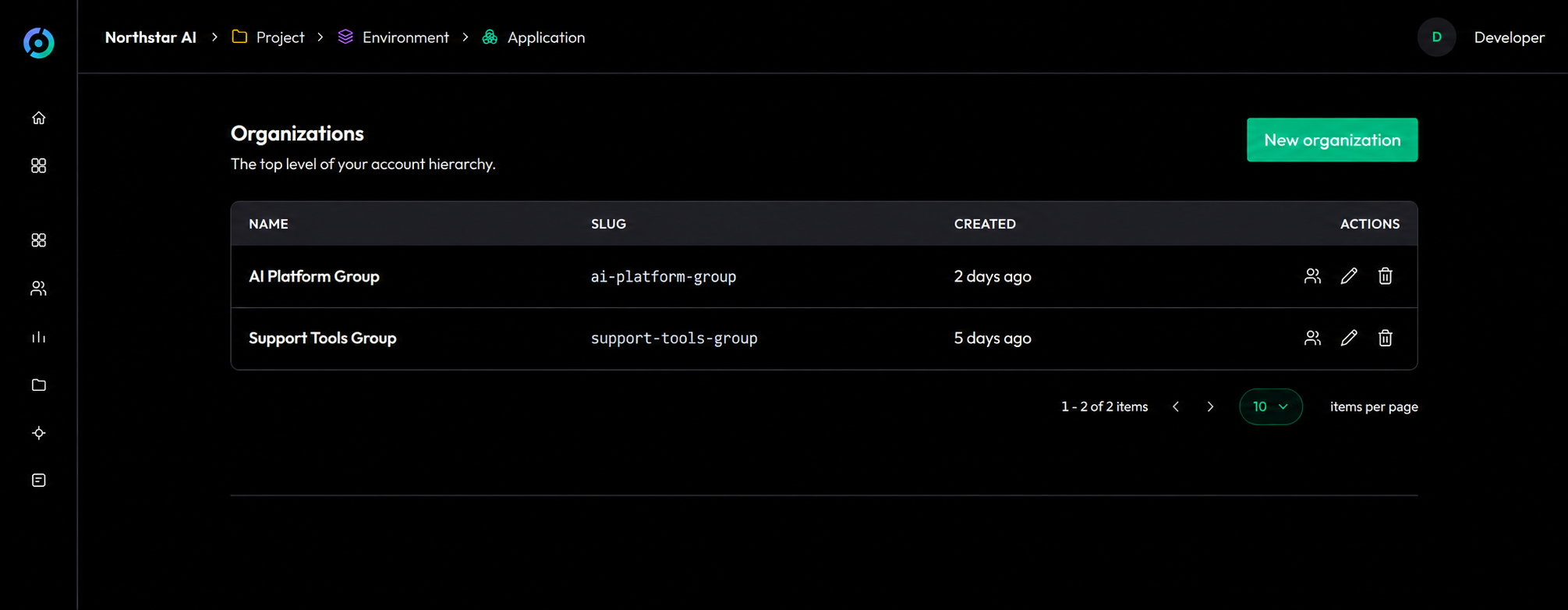
The engineer created a clear home for each workload before inviting the second team. That avoided using one undifferentiated project for unrelated applications and made the environment visible during day-to-day investigation. It also gave future contributors a vocabulary for asking for access to the right scope.
Give access based on the work, not the team name
With the workspace structure in place, the engineer reviewed the actual tasks requested. One contributor needed to inspect monitoring data. Another needed to manage team membership. Those are not the same responsibility.
The organization member controls in Observra distinguish owners, members with configurable permissions, and viewers with read-only access. The team used those controls to match access to each person's duties, then checked the resulting permissions rather than assuming that membership alone was sufficient. Changes that affect ownership or permissions stayed with the people responsible for administration.
This was a practical least-privilege review, not a claim that a hierarchy by itself guarantees isolation. The company still had to define its own data-handling policy, choose the right membership scope, and verify that the application's permission controls matched that policy.
A safer onboarding sequence
The team documented an order that future product groups could follow:
- Name the owner for the workload and decide whether it belongs in an existing organization.
- Create or select the organization, project, environment, and application context before connecting monitoring data.
- Invite contributors only after identifying the tasks they need to perform.
- Assign the narrowest appropriate role and review the permissions with the owner.
- Confirm that the team can find its own application and environment without relying on ambiguous names.
The sequence added a small amount of thought before the invite, but removed guesswork from later handoffs. Engineers could tell which team owned the workload, which environment they were investigating, and who could change access. When another service arrived, the team could place it deliberately instead of inheriting the first application's defaults.
Make the boundary explicit before it becomes urgent
Organizations and permissions solve related but different problems. The hierarchy helps a team describe where its services belong. Member roles help decide what people can do. In Observra, using both gave this platform team a clearer onboarding path for a second workload and a more deliberate review of contributor access.
The useful lesson is not to create the deepest possible hierarchy. It is to choose only the boundaries the team can explain and maintain, then make ownership and access visible before an incident or audit forces the decision.